
The EU Referendum was our generation’s ‘Sliding Doors’. If you haven’t seen the film, it alternates between two parallel universes; both show two paths the main character’s life could take, depending on whether or not she catches her train. Well Brexit is that train and, in this universe, we caught it. But not everyone is down for the ride. There are some who feel like they’re trapped on a hijacked vehicle. Uncertainty is the path it’s travelling, destination unknown. I’m talking about millennials. We voted overwhelmingly against Brexit because, while we may be the PYTs (Pretty Young Things) of the moment, we’re also PDS – Pretty Damn Stupid. We hold an impractical idealism which we’ll inevitably grow out of – at least that’s what we’re told. But is this really the case?
A new report from the Intergenerational Foundation lays the groundwork for such an inquiry. The report suggests two things:
1) As millennials, we didn’t favour Remain because of our youth per se, but because other aspects of our generational profile predisposed us to do so. In other words, millennial support for the EU is a generational effect, not an age-group effect, so we’re not likely to become eurosceptic as we get older.
2) Millennials are a diverse coalition of interest groups who voted Remain for different reasons.
Following a similarly rigorous academic approach, I conducted my own study using the most sacred of councils: The Whatsapp Group Chat.
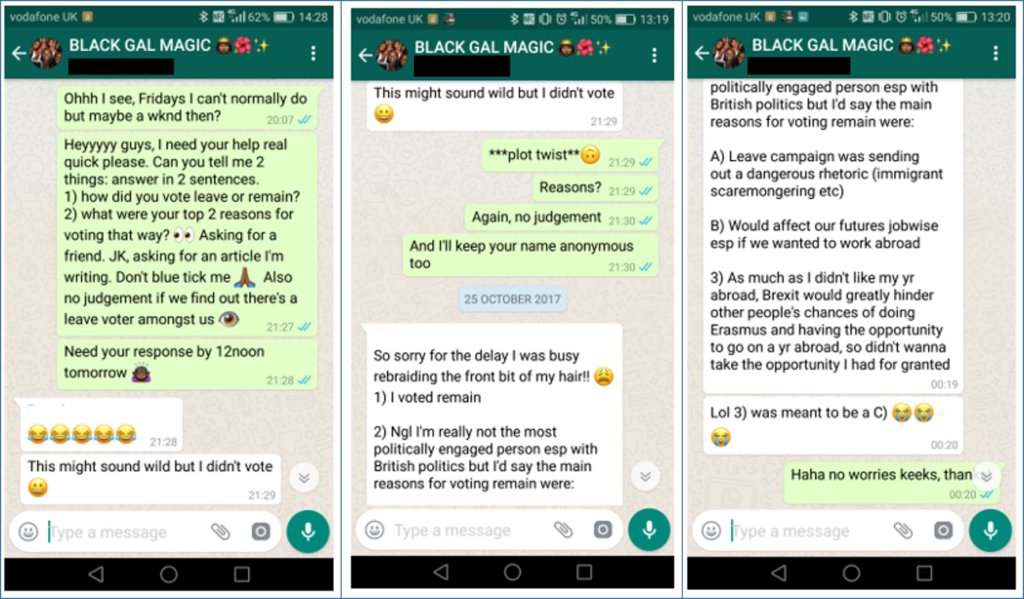
Just as the study indicated, my friends’ reasons were varied and called into question the dominance of socio-economic explanations in most Brexit debates. Think about the fact that millennials disproportionately face economic challenges such as stagnant wages, high housing costs and insecure work. So, if the Brexit vote became a means for economically disadvantaged groups to express their anger and frustration with the status quo, why didn’t millennials support Brexit?
I think it’s because, as a generation, we have new ways of relating to the world and each other. These act as ideological counter-weights to pro-Brexit sentiments, such as immigrant scapegoating, which economic dissatisfaction may otherwise have brought out. For example our generation, proportionately more so than previous generations, contains people who are highly-educated, non-white, live in cities and who may feel a weaker attachment to traditional notions of British nationalism.
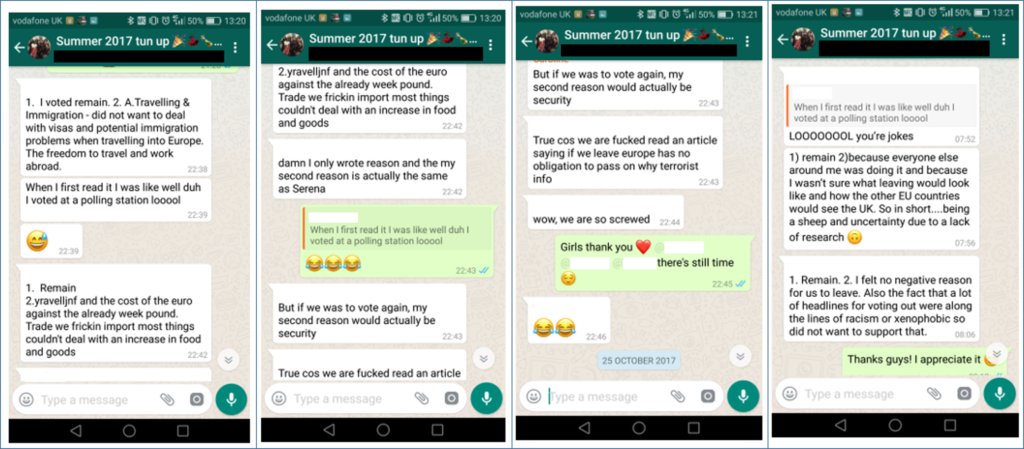
So yes, while economic challenges might have pulled many other groups in the direction of Brexit, for millennials this effect was mitigated by these other unique generational forces. The significance of this is only fully grasped when we acknowledge that future generations are likely to have a similar make-up. Numerous statistics show that the kids of tomorrow will be even more multi-ethnic, more educated and more globalised than millennials. So if these markers are indicative of pro-EU sentiment – and they are – then Brexit is just an unfortunate bump in the road to an even closer union.
Nevertheless, for the time being we find ourselves here. Trump is President. Corbyn is friends with Stormzy et al. I have a gym membership. This dystopian reality crept up slowly and even today choruses of ‘oh shit’ continue to be heard around the country. Yes, we’re basically living in an episode of Black Mirror and yes, it’s scary. But in this post-Kardashian universe where every moment is consumed, memeified and regurgitated in real time – I take comfort in the fact that the Internet keeps receipts. And in the future, those receipts will show that the Millennial generation were on the right side of history.