
Another day, another tax headline. This week, it’s Apple, which faces a €13 billion (£11bn) tax bill in Ireland from the EU. Everyone says there must be a better way to make business pay its way. I support boosting the tax take, too, though not by punishing companies. Earlier this year, I argued in The Conversation that it was time for progressives to think the unthinkable and get rid of corporation tax.
UK politicians remain to be convinced, alas. The All Party Parliamentary Group’s recent report on the global tax system stated:
Some experts have argued that we should stop trying to tax the profits of global companies. We disagree. Governments need a range of taxes to fund public services and corporate profits form one part of that range.
They haven’t recognised that you could bring in much the same revenue for the state by shifting the burden to shareholders. How? By fully taxing company dividends – and reaping the tax proceeds of people selling UK shares that have risen because of companies becoming more profitable after being freed from corporation tax.
But here I want to propose another carrot: charge companies an annual fee to be registered in the UK.
Ever-decreasing corporation tax
Corporation tax brings in around 6% (net of dividend allowance) of UK tax revenues. Former chancellor George Osborne intended in the wake of Brexit to cut UK rates from the current 20% to 15% of companies’ pre-tax profits. Philip Hammond, his replacement, has yet to announce a policy but has signalled he may move in the same direction.
Coupled with further erosions to the corporate tax base due to internet trading and the relocation of intellectual property to more favourable tax regimes, the day is soon likely to arrive when the UK struggles to raise 4% of its tax revenues from corporation tax. What’s this in money terms? Say £20bn (compared to £30bn, net of tax credits, in 2015-16).
So how much corporation tax would be raised on average from UK companies each year if tax revenues fell to £20bn? There are 3.5m limited companies in the UK. But 2m are dormant, so only 1.5m are actively trading. This means that each company would be paying just over £13,000 each year to HMRC on average.
I don’t know the average cost of a company complying with corporation tax each year, but it won’t be far removed from £13,000 (much higher for multinationals, much lower for small companies). And while companies only pay taxes when they make profits, they must make tax returns either way. It’s also worth remembering that many companies are subject to investigations, make appeals and sometimes end up in court – more costs.
Plan B
Now suppose we charged an annual fee for the privilege of being a UK company, using a fee scale based on company size. While companies would now be paying to be UK-registered, most would save more by not having to comply with corporation tax.
You could set the fee levels to bring in roughly what the government lost in corporation tax. In addition, the government would still have the revenue from the higher dividends and capital gains I mentioned earlier. In total, the income for the state would have risen substantially.
Collection of this fee would be simple. Companies would pay it when they deliver their confirmation statement (the replacement for the annual return). Penalties and interest would apply if payments were late – another source of money for government.
More information would be required to determine the number of fee bands and the charge per band for these new company fees, but below is a possible structure. Though the rates would of course be much higher for big companies, these are probably still comparable to what they spend on dealing with their tax affairs.
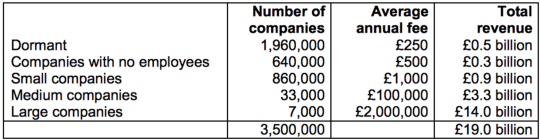
I’ve spoken to a few people who run or are involved with companies about how they would react to a system like this. What was their reaction? They’d bite your hand off to sign up, basically.
And a final thought. If the UK abolished corporation tax, where do you think Apple, Google and others would consider relocating given the problems the EU has created for Ireland?